|
|


The Scovill & Adams Company made a wide spectrum of interesting cameras, almost
all of which are relatively uncommon today. In addition to traditionally styled view
cameras, the company offered apparatus built in the English compact style - view
cameras that fold into a very compact "footprint."
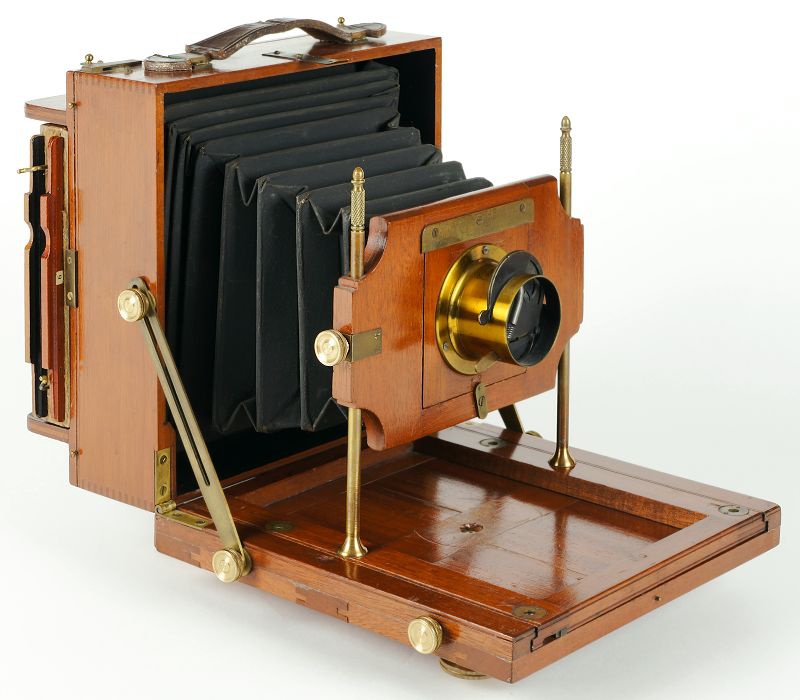
The Compact View is an American interpretation of the classic English compact veiw camera pattern. Believed to be in production from 1882 to 1898, it is constructed of polished mahogany featuring a cone bellows, brass trim, interchangeable lensboard, and patent reversible swing-back. The American Optical Company (an S&A subsidiary) also offered the same camera with a higher grade finish.
In an age of boxy straight lined apparatus, the Compact View is a rare and unusual camera, distinguished by its sculptured front standard mounted on a pair of solid brass posts with beautifully milled "pineapple" decorations.
The concave quarter-round shapes, notches and rounded edges on the front standard are purely ornamental and not found on any other camera in the Scovill & Adams inventory.
The design was certainly a radical departure from traditional square shaped front standards, especially on the more conservative English compact designs. Looking at the front standard, I wonder what inspired this exotic look? From a manufacturing perspective, the front standard must have been expensive to fabricate and finish yet the result is esthetically pleasing.
The Compact View is an American interpretation of the classic English compact veiw camera pattern. Believed to be in production from 1882 to 1898, it is constructed of polished mahogany featuring a cone bellows, brass trim, interchangeable lensboard, and patent reversible swing-back. The American Optical Company (an S&A subsidiary) also offered the same camera with a higher grade finish.
In an age of boxy straight lined apparatus, the Compact View is a rare and unusual camera, distinguished by its sculptured front standard mounted on a pair of solid brass posts with beautifully milled "pineapple" decorations.
The concave quarter-round shapes, notches and rounded edges on the front standard are purely ornamental and not found on any other camera in the Scovill & Adams inventory.
The design was certainly a radical departure from traditional square shaped front standards, especially on the more conservative English compact designs. Looking at the front standard, I wonder what inspired this exotic look? From a manufacturing perspective, the front standard must have been expensive to fabricate and finish yet the result is esthetically pleasing.
The 5x7 Scovill Compact view sold for $20 in 1892, which is about $379 in year 2000 dollars.
Compact View, c.1892
Scovill & Adams Co., NY
Scovill & Adams Co., NY
Copyright ©2000 - 2014 by Rob Niederman - ALL RIGHTS RESERVED
Visit the Scovill Compact View Camera Reference page
Return to the View Cameras page
Return to the View Cameras page
Multi-Lens Cameras | View Cameras | Self-Casing Cameras | Solid Body Cameras | References & Advertisements
Home | What's New | Show Schedule | Wanted | For Sale | Links | Site Map | Email
Home | What's New | Show Schedule | Wanted | For Sale | Links | Site Map | Email
Ironically, the camera's rarity is possibly due to the elaborate front standard. Using the camera is a complicated affair because the brass posts must be unscrewed from the bed
when closing the camera, and screwed to the bed when opening the camera. No matter how a photographer used the camera, the brass posts were always being removed or
changed. I believe these actions eventually led to a number of damaged cameras, especially the bellows and front standard mounts.
In comparison to other cameras available at the time, the overall design appears to be very impractical considering the potential for damage; which may explain why there are only a few examples extant of this earlier style. Realizing the problem, Scovill & Adams may have changed the design to a traditional (square) front standard sometime after 1892, however the exact date is unknown.
In comparison to other cameras available at the time, the overall design appears to be very impractical considering the potential for damage; which may explain why there are only a few examples extant of this earlier style. Realizing the problem, Scovill & Adams may have changed the design to a traditional (square) front standard sometime after 1892, however the exact date is unknown.
The 5x7 inch Scovill & Adams Compact View with
rare Goerz Choroskop II landscape lens and shutter.
rare Goerz Choroskop II landscape lens and shutter.
This particular camera is a 5x7 inch format
with Goerz Choroskop II landscape lens and
shutter. A tripod turntable and brass focusing
knob are located underneath the bed. "Scovill
& Adams, Company, NY" markings are found
on the leather strap and maker's label on the
back; implying a manufacturing date between
1889 and 1898. (Note: the Scovill & Adams,
Company, NY naming terminology was in use
from 1889-1902.)
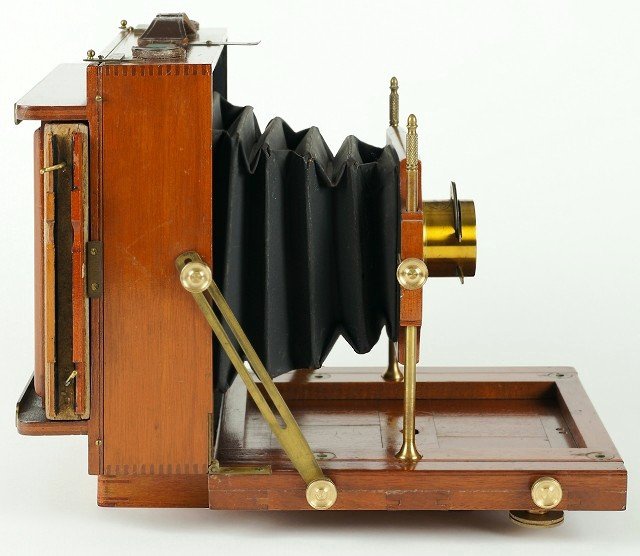
However the ground glass back provides additional clues to help pinpoint a specific manufacturing year. The rear assembly on this camera does not match the English compact style back shown in the 1892 catalogue entry, but is representative of a pattern found on the St. Louis Reversible Back Camera made from 1885-1889. Since the back has matching build/lot numbers (#23) with the rest of the body, it is considered original to the camera.
Left: Profile view showing St. Louis pattern ground glass assembly.
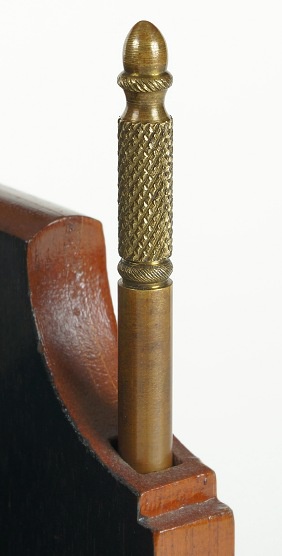
Right: Detail of brass post top. Reminiscent of a "pineapple" bed post, the milled section is a functional decoration that provides a convenient nonslip grip when tightening or loosening the support posts.
However the ground glass back provides additional clues to help pinpoint a specific manufacturing year. The rear assembly on this camera does not match the English compact style back shown in the 1892 catalogue entry, but is representative of a pattern found on the St. Louis Reversible Back Camera made from 1885-1889. Since the back has matching build/lot numbers (#23) with the rest of the body, it is considered original to the camera.
Left: Profile view showing St. Louis pattern ground glass assembly.
Right: Detail of brass post top. Reminiscent of a "pineapple" bed post, the milled section is a functional decoration that provides a convenient nonslip grip when tightening or loosening the support posts.