Antique & 19th Century Cameras
Antique & 19th Century Cameras
Flat Folding Kodak, 1895-97 (page 2)
Eastman Kodak Company. Rochester, NY.
Dating the Flat Folding Kodak and Understanding its Production There is some confusion about the availability dates. What should be taken into account are the years the camera could actually be purchased and its catalogue listings and advertising. The Flat Folding Kodak appears in advertisements from March 1895 to Kodak’s U.K catalogue of June 1897.
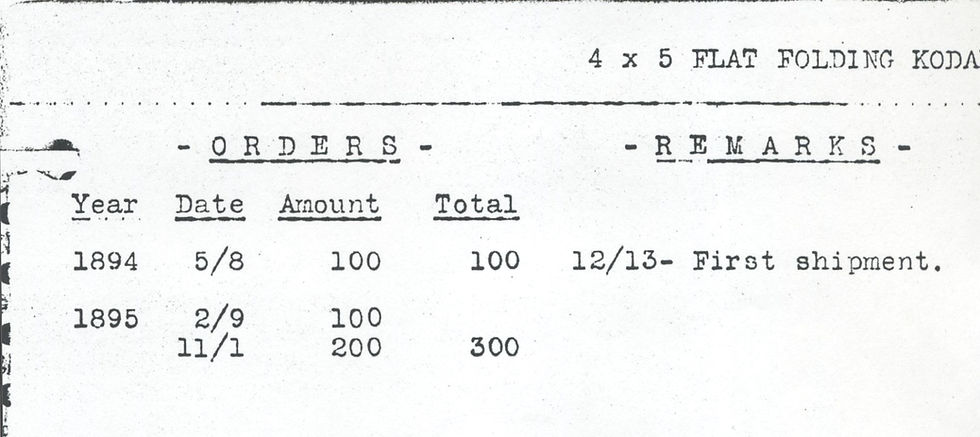
For 1895, there are two order entries for an additional 300 cameras. At this time, there is no documentation stating if all or a portion of the 300 orders were manufactured. By Kodak standards, 100 cameras are a very small production number. Is it possible that the 1895 cameras were an improvement on the 1894 design? For example, one improvement is updating the bellows from square corners (1894) to chamfered corners (1895). As a note, Kodak had shifted most of its production to bellows with chamfered corners from 1895 on.
Summary of Production Changes Information provided by other collectors provides an opportunity to closely examine and compare cameras. A comparison of the ten cameras uncovers six feature and build changes. Of the updates / improvements, the most important might be the bellows modification from square to chamfered corners as noted previously. Chamfered corners have better durability and wear than square corners.
In looking at six design characteristics, three camera styles emerge: Early, Transitional, and Improved. Unlike the Folding Kodak series which includes a name change adding the term "Improved," Kodak did not update its Flat Folding Kodak listings to disclose improvements and design changes. For example, all advertising from 1895 to 1897 have illustrations of square cornered bellows even though five of the cameras have chamfered bellows.
The following chart groups cameras by key features and changes. At a glance, Flat Folding Kodak cameras with square bellows represent the primary feature defining an early build. Square bellows models also have the lowest body and lens serial numbers.
The transitional camera in Figure 4 belongs to the Bradford Museum in London. It is assessed from a picture appearing on page 89 in Brian Coe’s book Kodak Cameras – The First Hundred Years. Queries for additional detail were sent to the museum and replies have not yet been received. Otherwise, the Bradford camera has square cornered bellows (early) plus later features. This is somewhat uncommon for Kodak because the company often revised model names (i.e. Model A, Model B, etc.) when updating and adding features. And while improved cameras have shutter tensioning levers centered on the lens board or located to the right, there is no explanation why there are two positions.
Figure 5 below compares the bottoms of early and late models. There are two depressions: the left is dedicated to a back locking lever and the right accommodates a winding key, film counter and locking lever. Updates include reshaping the body depressions and changing the film counter material from ivorine to brass.
Later cameras also include a minor mechanical improvement that adds a button shown in Figure 6 below. Back removal is done in two steps. The first step is to remove the winding key by unscrewing it clockwise. On later cameras, the button must be pressed at the same time as unwinding the key. This stops the key from spinning freely. Next, both brass levers are turned toward each other so that they are parallel to the front. The back can now be removed.
Page 1
End Note:
[4] Detail is from the Kodak Camera Production Order Book (1885-1920) George Eastman Museum; Gift of Eastman Kodak Company Patent Museum: The order book is a series of three-ring binders donated to the museum from the Eastman Kodak Company Patent Museum; it was part of a file which the company donated to the museum in December 1989. (Information courtesy of Todd Gustavson, George Eastman Museum.)
Continue to Flat Folding Kodak - page 3
Return to the Self-Casing Cameras page
Copyright ©2023 - 2026 by Rob Niederman - ALL RIGHTS RESERVED
Figure 3: Detail of the Flat Folding Kodak entry in Kodak’s Camera Production Order Book


Page 3
%20of%20Flat%20Folding%20Kodaks.jpg)


Figure 5: Body comparison of early and later cameras
Figure 4: Three styles (models) of Flat Folding Kodaks
Figure 6 shows the back of a later model camera in the collection of Jos Erdkamp. The design includes a button to lock the winding key from spinning. Early models do not have the button.
Two non-factory April 1895 advertisements mention the camera as "new" or "introduced." Several online websites stating the camera's 1894 market presence is more than likely a misinterpretation of information from Kodak's Camera Production Order Book.
As background, Kodak maintained a series of three-ring binders that tracked equipment "orders." Even though the Flat Folding Kodak was advertised from 1895 to 1897, Kodak's Camera Production Order Book has a page listing entries totaling 400 “orders” for the years 1894 and 1895.[4]
It is important to consider that orders do not necessarily equal actual camera production; yet the 8 May 1894 order listing has a 13 December 1894 comment stating the initial order of 100 cameras as "First shipment." This might imply all ordered cameras, or a portion of the order, were being scheduled or shipped to Eastman Photographic Materials Co. Ltd., London for the 1895 model year.