Antique & 19th Century Cameras
Antique & 19th Century Cameras
Flat Folding Kodak, 1895-97 (my research paper)
Eastman Kodak Company. Rochester, NY.
In late 2023, I acquired a fine example of the elusive Flat Folding Kodak; a camera I had been chasing for over twenty years. When starting my usual research, I discovered a camera advertised as “The Cyclists and Tourist’s Comrade” (Photographic News. August 23, 1895) yet somewhat shrouded in mystery and often misunderstood. On the surface, its looks like an 1890s self-casing, roll film camera similar to the earlier Folding Kodets and later Cartridge Kodaks. Unlike those other series, which consist of many models with feature changes, there appears to be one version of 400 cameras produced by Frank Brownell’s Camera Manufacturing Company for Eastman Photographic Materials Co. Ltd., London.
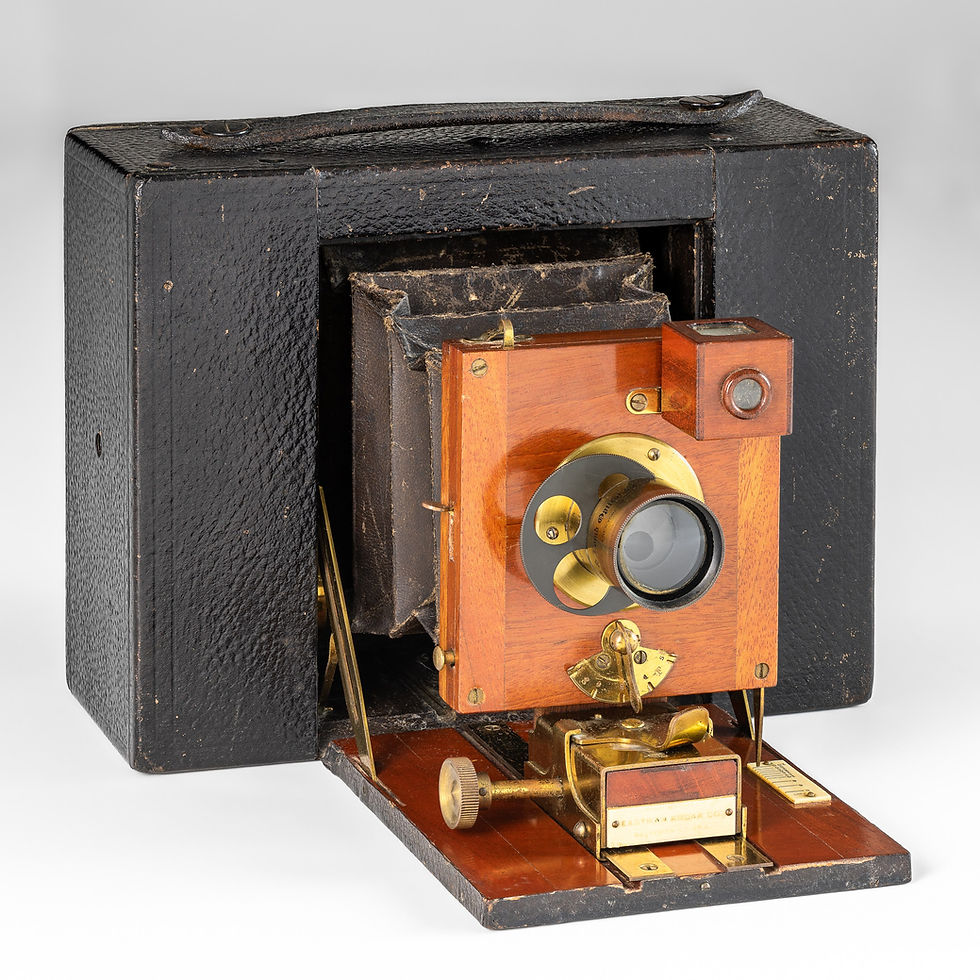
Self-casing cameras changed when, in 1893, Thomas Blair introduced a new, smaller roll film and plate camera called “The 400”[1]; a portable folding bellows pattern for 4 x 5" pictures on roll film and plates. For some reason, maybe as a way to get around Eastman's control of roll films and patents, Blair chose to sell his new camera in the United Kingdom (U.K.) under the name of “Folding Kamaret.” The key to Blair's camera was eliminating the need for a separate roll film carrier by incorporating the film spools into the camera body and positioning them on either side of the bellows.
The Folding Kamaret might have caught Eastman's attention for two reasons: back in 1891, Eastman commented that the company's long-term strategy was film[2] and at the time of Blair’s 1893 introduction Kodak did not have an equivalent side-spool body pattern.[3] Given the success of the Folding Kodak cameras and a publicized commitment to film, it was inevitable that Eastman respond to Blair.
In 1895, Eastman entered the U.K. market with the Flat Folding Kodak which was made in Frank Brownell's U.S. factory. As of this research, there are no records explaining why Eastman chose to sell the camera in the U.K., but a plausible explanation might have been to counter Blair's design as well as open new market opportunities.
Advertisements from 1895 imply that Eastman’s new camera, without directly stating as such, was a simpler, less expensive alternative to the Blair 400: £7 vs. ~£12. Though somewhat similar in styling, the Flat Folding Kodak made up to 48 exposures on Eastman's Transparent Film while the Blair 400 made 50 on 4¼" film. In regards to size, the cameras are identical; both advertised as 6½" high x 8½" wide x 3½" deep, which is possibly another indicator that Eastman's camera was meant to compete with Blair's.
With the elimination of boxy roll film carriers (i.e. the Eastman Walker holder), roll film mechanics were placed onto the inner, removable back creating a significantly thinner body, as shown in Figure 2. This might have inspired the name "Flat" Folding Kodak. The name could also have conveyed to customers a feeling of small size and portability.

Page 2
End Notes:
[1] Illustrated Catalogue and Price List of Photographic Apparatus and Supplies Manufactured and Sold by the Blair Camera Company. The European Blair Camera Company. Ltd., London. 1893. p.16.
[2] Eastman's long-term strategy is noted by Reese Jenkins in his book Images and Enterprise (1976. p.98): "... perfection of a system of film photography that would supplant the use of glass dry plates." - Affidavit of George Eastman filed 23 May 1891, Eastman vs. Blair.
[3] Author’s comment: To distinguish between box camera roll film patterns and bellows cameras that accepted separate roll holders (i.e. the Eastman-Walker carrier), I refer to this new approach as a side-spool body design.
Continue to Flat Folding Kodak page 2
Return to the Self-Casing Cameras page
Copyright ©2023 - 2026 by Rob Niederman - ALL RIGHTS RESERVED
Figure 2: Rear view of camera showing how the integrated roll-film back fits into the body

Figure 1: Early build of the Flat Folding Kodak
To many collectors, the Flat Folding Kodak is an enigma: an insignificant blip in the grand oeuvre of early Kodak equipment. With only ten examples known worldwide, it has proven to be a difficult camera to study and accurately document. Most information known today, albeit limited, appears on page 89 of Brian Coe's book Kodak Cameras – The First Hundred Years. At the time Coe wrote about the Flat Folding Kodak, he might have only seen one or two examples because there are no variations which are normally listed in his book.
As a collector and historian, I felt the Flat Folding Kodak’s story needs more detail. Starting with contacting other owners to compare our examples and document variances, my investigation extended to museums and other institutions around the world. While new information has been added to the camera’s narrative, there remain unanswered questions.
This article describes new information and open questions undergoing further study. For now, the reason why the camera was made, manufacturing dates, design changes, and production quantities are better understood. Advertising was found indicating the cameras’ possible market introduction. Research also uncovered a puzzling question of why the camera continued to be promoted in Australia years after it was discontinued.
The Beginning In the 1890s, George Eastman was reshaping the photographic equipment landscape with innovative self-casing folding-bellows cameras offering an alternative to more complicated, equivalent format field-view cameras. It started in 1890 with the innovative Folding Kodak series, which established a new body pattern influencing designs well into the 20th century. Eastman's quest to improve on the folding bellows design during the 1890s included the introduction of Folding Kodets (1894 to 1897) which briefly sold concurrently with Folding Kodaks (1890 to 1897).
A Collecting Misunderstanding At first glance, the Flat Folding Kodak looks like a mash-up of two Kodak portable bellows cameras; the earlier Folding Kodet series (1894 to 1897) and the later Cartridge Kodak cameras (1897 to 1907). It is the two-camera look that also makes a fascinating backstory that was shared with me by the camera’s former owner.
In the early 1970s, a U.S. dealer's son purchased the camera in England and brought it into the United States. It was sold to a prominent New York based dealer. The new owner felt it was probably a "fake" made of parts from a Cartridge Kodak and Folding Kodet. He returned it. The camera was then resold to another collector who found advertising proving the camera was real. The last owner acquired it in the late 1970s and kept it for over 40 years before selling it to me.
It is possible this particular camera is one of the first identified Flat Folding Kodaks. A couple cameras were probably in collections at the time as nothing more than unidentified apparatus. Without period ephemera, it isn't surprising that this camera was considered a fake because pre-Internet research was slow and difficult. And, it is understandable that a very experienced dealer had doubts. Nevertheless, it must have taken a lot of energy and work in the 1970s to find original advertising.