Antique & 19th Century Cameras
Antique & 19th Century Cameras
Premo Supreme, 1902 - 08
Rochester Optical Company. Rochester, NY.

Offered from 1902 to 1908, and available in three formats from 4 x 5” to 6½ x 8½”, the Premo Supreme was positioned as an upscale version of the company’s full-featured Pony Premo No.7. Adding to the camera’s visual uniqueness, nearly all hardware is decorated extensively with a surface-etched design called ‘perlage,’ an overlapping pattern of small circles made with specialized machinery. It is best known as an ornamental style found in high-quality watch movements, but also seen on early car dashboards and the nose of Charles Lindberg's Spirit of St. Louis aircraft.

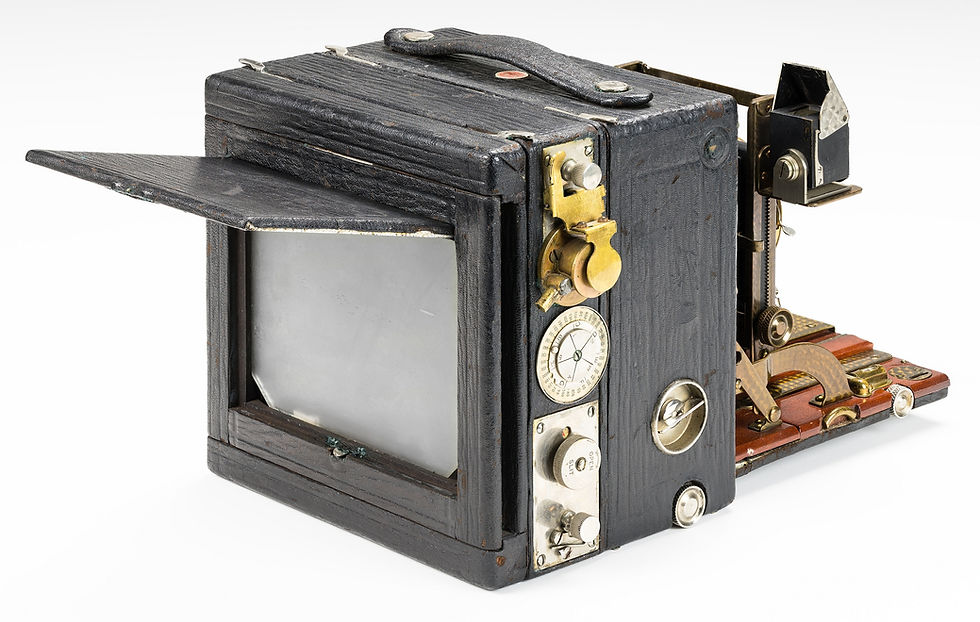
Rear view showing the spring loaded viewing door and the TP shutter.

Price for this level of quality and workmanship was not cheap. In 1902, the 4 x 5” camera listed for $146.00 when outfitted with the brass Volute shutter and Goerz Double-Anastigmat Series III lens option. Taking inflation into consideration, this equates to $5,687 when adjusted for 2026! (Today, that level of investment will buy a professional DSLR.) In comparison, the similarly featured but less elaborate 1902 Pony Premo No.7 was only $80.50. Interestingly, the 1903 price for a Premo Supreme model with nickel-plated hardware drops slightly to $140.00, but is still very expensive.
In total, the Premo Supreme’s complex, steampunk appearance could fit well into an alternative reality sci-fi story. While fancy hardware embellishments don’t contribute to making better pictures, it is meant to showcase makers’ craftsmanship and artistry. Perhaps cameras with all of these characteristics made their owners feel special or even privileged.
Although richly featured and elaboratively constructed, very high prices for Premo Supreme cameras might be a reason they are rarely found today. Maybe professionals did not see value in the excessive decorations and exotic materials. Regardless, its steampunk look attracts me and it definitely stands out when displayed next to my other self-casing cameras.
Return to the Self-Casing Cameras page
Copyright ©2026 by Rob Niederman - ALL RIGHTS RESERVED
Fully extended bellows showing the reach of a triple extension design.
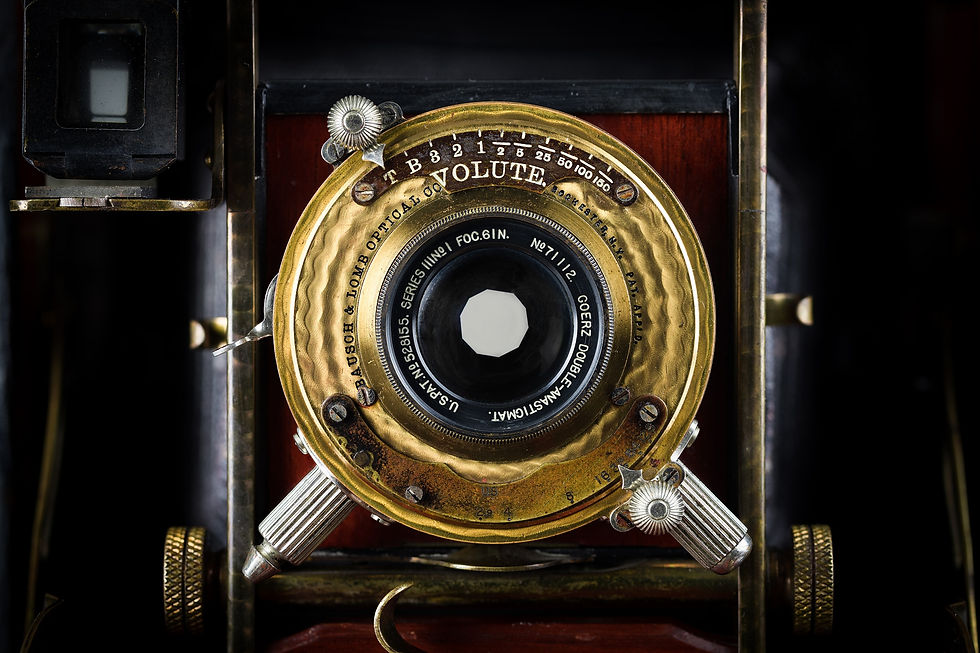
Premo Supreme. 1902 4 x 5" format with a triple extension bellows. Volute and Thornton Pickard shutters and a Goerz Double-Anastigmat Series III lens.
ROC’s 1902 catalogue refers to the decorated hardware as “rococo lacquered” brass. From 1903 on, “Damaskined nickel” was used; which is probably marketing jargon for perlage patterning applied to nickel-plated brass.
Two shutters were standard on the Premo Supreme. Mounted to the removable lens board is Bausch & Lomb’s “Golden” Volute diaphragm brass cased shutter which has an etched (engine-turned) wavy pattern on its face.
The second shutter is a removable focal-plane Thornton Pickard (TP) roller-blind model positioned between the body and its ground glass frame. According to ROC’s 1902 catalogue, the TP shutter is for photographing fast moving subjects that cannot be captured clearly with the Volute’s top speed of 1/150th of a second:
Genuine seal leather covers the wood body and, in contrast to the majority of cameras with red-leather bellows, black leather bellows was the only option. This was probably because thin red-leather often wore out. ROC catalogues describe the bellows as “black Persian levant leather.”
Other features include a triple extension bed and bellows for long focus lenses, geared focusing and body movements, reversible back, short accessory bed rail for using wide-angle lenses, large lens board for different lenses, and precision Bausch & Lomb Iconoscope viewer.
“For those desirous of obtaining instantaneous photographs of subjects having an extremely rapid movement, such as flying birds, animals, and men leaping, jumping, automobile races, etc., this is the shutter preeminent. It gives a shorter exposure and passes a larger percentage of light than any other form.”

Premo Supreme appears in gold under the viewing lid.
If I were to nominate one camera as 'best in show' for a sci-fi alternate universe, steam-punk look, this would be it. The majority of American self-casing cameras have bodies covered in black leather accompanied by interiors of polished wood and lacquered brass. By 1904, most makers changed the metal hardware to bright nickel-plated brass. At the same time, fragile red leather bellows were redesigned for a thicker, more durable black leather. Over time, these increasingly popular cameras became somewhat “utilitarian” in construction and appearance: They looked the same.
At the peak of popularity, if not for their makers’ labels, the majority of self-casing cameras were indistinguishable. When reviewing catalogues, I often have to reread listings and compare illustrations several times to fully understand the differences. Not surprisingly, some companies differentiated their products by offering deluxe models with advanced features and better material quality.
While the Rochester Optical Company (ROC), one of the dominant builders at the time, was already selling a large variety of red-bellows self-casing cameras, most, if not all, were strikingly similar in appearance and pricing to competitors’ apparatus and vice versa. As a departure from this “sameness,” the Premo Supreme appears to be a differentiation tactic to reach a high-end niche market of amateurs and professionals. The first catalogue listing for the 1902 camera sets a big expectation:
“In no way is the marvelous inventive and constructive genius of the age more strongly displayed than the production of the Premo Supreme. Every conceivable requirement and improvement that experience, science, and practical testing have shown of value in a camera are combined in this instrument with the greatest mechanical precision and ingenuity. It is the most advanced type of camera that the world has ever seen. It marks the utmost possibility of excellence and completeness. Amateur and expert alike recognize in this wonderful instrument the very best of best in camera construction.”

The bed can be dropped when using wide-angle lenses.