Antique & 19th Century Cameras
Antique & 19th Century Cameras
American Gem No.2, 1881
August Herzog's Toy Cameras - page 2
Regardless of its name, Herzog's Popular Photograph Camera is nothing more than a wood stand and base with a truncated fiberboard body holding a brass lens tube mounted into a square wooden face.
The build is strictly no-frills and includes a handy hole at the top of the wooden stand; perfect for a child's or adult's finger to carry it. Nevertheless, the camera was probably much too fragile for younger photographers and a second model soon followed: the American Gem No.2. With a bit of ingenuity, Herzog made the succeeding camera larger and sturdier with the addition of braces to reinforce the wood frame, and replaced the fiberboard body with a structurally solid, metal hemispherical form. To ensure learning the art of photography was as easy as possible for his second camera, in 1880 Herzog wrote a booklet entitled Photography Without A Teacher.


Return to the View Cameras page
Copyright ©2013 - 2026 by Rob Niederman - ALL RIGHTS RESERVED
Herzog Page 1
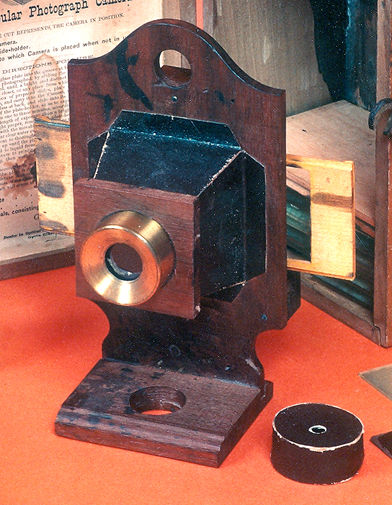
Herzog's 1876 Popular Photograph Camera. This first version camera was originally in the collection of Wayne Cogan before being sold to Jack Naylor. (Image courtesy of Jerry Spiegel.)
Herzog Page 3

In 1872, August Herzog created a clever trademark-logo by graphically marrying his initials "A" and "H". On the 1881 model camera, patent information accompanies the logo.
ca.1882 Herzog Amateur Camera (improved model). George Eastman Museum collections. August Herzog, New York, NY. Gift of Eastman Kodak Company. 1982:0237:0010
The 1881 American Gem No.2 shown on the first page of this post was upsized to shoot standard 3¼ x 4¼" plates yet retained its distinctive finger-hole. It is sleeker in appearance and more substantial to survive the rigors of enthusiastic children. Taken as a whole, the American Gem No.2 continues with the original model's concept of simplicity while being devoid of advanced features such as rise/fall movements, geared focusing and so forth. In addition to the elegantly hemispherical, nickel plated metal body, which gives the camera a nouveau style look, the sliding lens tube is now mounted in an ebonized wooden collar and held in place with a knurled brass knob. To ensure the lens tube could not be misplaced, the rear barrel edge is flared outward to prevent it from being pulled out of the body; yet I did accidentally push it completely into the metal body!
It also includes its original wooden case with paper maker's label, metal lens cap / shutter, double plate holder, and tripod. The camera is also marked with August Herzog's 1872 trademark and three patent dates of Sept. 12, 1876 (camera), Sept. 20, 1881 (reissue), and Oct. 11, 1881 (plateholder).
A paper label inside the wooden case's lid reaffirms the patent's product description that this is an educational tool 'For Family Use' and being "manufactured for the purpose of teaching those who take an interest in Photography, and for those who desire to spend a little more money for a better article." The label also notes the apparatus is "of the same construction as the one previously described but has a 3¼ x 4¼" Patent Dry Plate-holder, to admit two prepared plates at one time, and also an Achromatic Lens for producing a more perfect picture in taking portraits or views."
Additionally, there is a list of twenty-two items making up the outfit including a teaching book and chemistry to be stored in the wooden case. As with the 1876 model, there are only a couple examples of the second version, one of which, in the collection of the George Eastman House, is fitted with a petzval formula Darlot lens in a rack & pinion focusing barrel.
